
Arrest Warrants in Guadalupe County
An arrest warrant tells an authorized officer to arrest a named person and bring that person before the court without unnecessary delay. In Guadalupe County, the paperwork usually runs on two state forms. New Mexico Form 9-210 carries the command itself: the offense, the execution range, the judge and date, and the return fields. Form 9-209 supplies the sworn affidavit when the complaint alone does not lay out enough facts for a probable-cause finding. The warrant belongs to the issuing court, and every question about it goes back there. A district felony file routes to the Fourth Judicial District Court at 575-472-3888. A magistrate or municipal matter stays with the lower court named in the case. The sheriff serves papers and enforces the law, but that office does not decide whether the charge or the warrant gets recalled; only the issuing court does that.
The Fourth District Probable-Cause Arrest-Warrant Route
For a district criminal file in Guadalupe County, the Fourth Judicial District Court sits at 1448 Historic Route 66, Suite 5, Santa Rosa, and the official directory lists 575-472-3888. A clerk there can pull up the case and explain the current filing or appearance process. What the public materials do not promise is a walk-in surrender, a bond window, or same-day review by a judge. So ask directly. Does the case include an arrest warrant? What bond or appearance terms apply? Should counsel coordinate a motion or a surrender before you act? Never infer a bond amount or a release condition from a general form, because a case-specific court order controls. The court's official location page shows the local contact route for Guadalupe County.
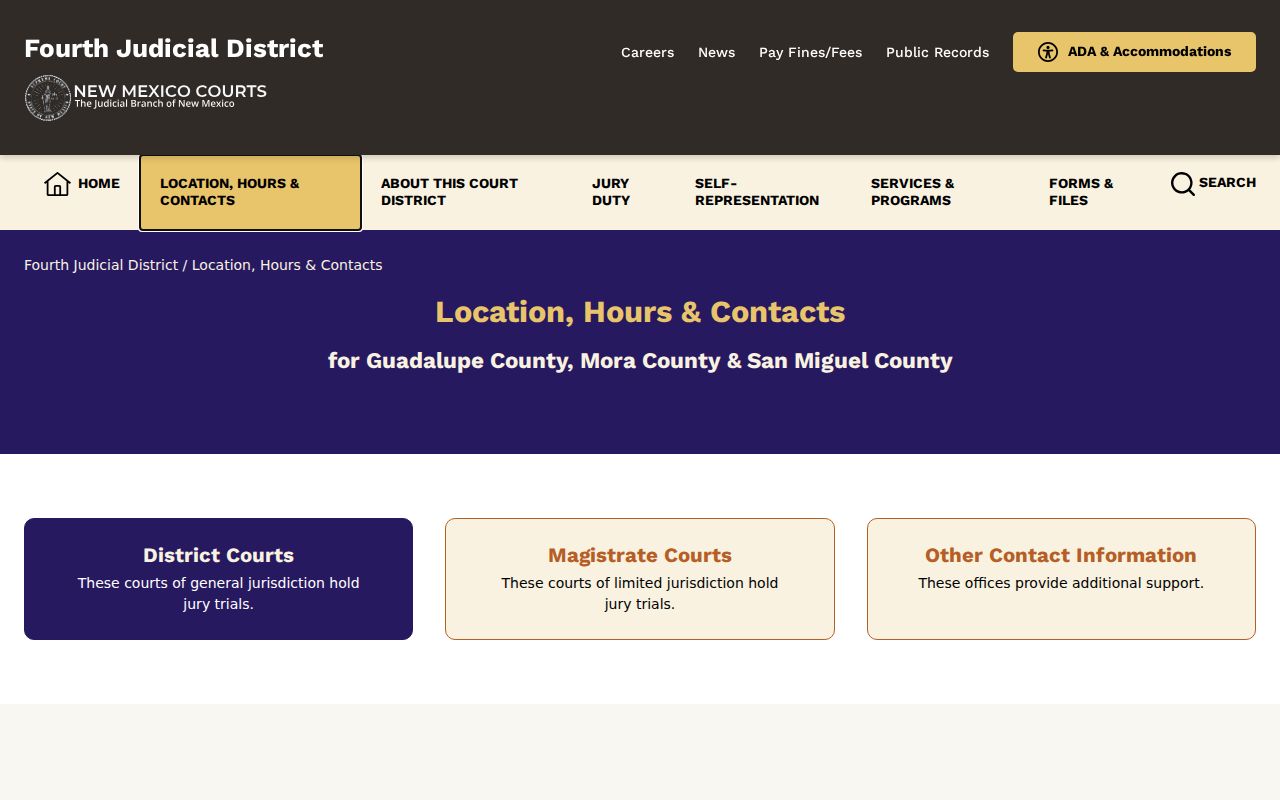
Call before traveling and ask which office should receive the next request.
How a Guadalupe County Arrest Warrant Is Issued
The paperwork behind a Guadalupe County arrest warrant starts with Form 9-209, which requires sworn facts establishing probable cause that the named defendant committed the stated offense. Form 9-210 then directs an authorized officer to arrest the defendant and bring them before the court. It can list the statute or ordinance, the issuing judge, the date, the geographic execution range, and the originating agency. Still, the case has to move through the court. An arrest warrant can sit alongside a pending charge, and by itself it does not resolve the merits of anything.
- Identify the complaint, affidavit, or case number.
- Confirm the issuing court and offense description.
- Ask the clerk about bond and the next appearance.
- Ask counsel how to arrange a lawful appearance or surrender.
District, Magistrate, and Municipal Arrest Warrants Compared
New Mexico splits criminal authority across its court levels. The district court takes felony matters. The magistrate court takes misdemeanors and traffic cases. Santa Rosa and Vaughn municipal courts handle city traffic, DWI/DUI, petty misdemeanors, code violations, and animal-control cases across Guadalupe County. Each court can run its own arrest or bench-warrant process, so the court named on the paperwork matters.
| Court level | Local Guadalupe route | Typical record question |
|---|---|---|
| District | Fourth Judicial District Court, 575-472-3888 | Felony case, Form 9-209 or 9-210, bond or appearance |
| Magistrate | Guadalupe Magistrate Court, 575-472-3237 | Misdemeanor or traffic case and court status |
| Municipal | Santa Rosa 575-472-4232 or Vaughn 575-584-2206 | City citation, ordinance, or petty-misdemeanor process |
The Guadalupe County clerk handles recordings and elections, not criminal warrants. For warrant questions, that office is the wrong door.
What a Guadalupe County Arrest Warrant Shows
Read a Guadalupe County arrest-warrant record as two pieces: the court's document and the return. Some of what it holds may be protected. Do not publish personal identifiers. The useful public questions concern the court, the charge, the judge, the execution authority, and where the case stands now.
| Issuing court and case | Court, county or municipality, case number, and named defendant |
|---|---|
| Probable-cause offense | Charge, New Mexico statute, or municipal ordinance cited in the process |
| Execution range | Any jurisdiction, statewide, county, or city authority stated on the form |
| Judge and date | Judicial signature or issuance information |
| Law-enforcement entry | Information-system entry or transmission when required by the form |
| Return | Arrest or service date, officer signature, release, and removal information |
A public case screen may show only part of the record for a Guadalupe County case. Ask the issuing clerk for the current status.
Execution Jurisdiction on a Guadalupe County Arrest Warrant
Form 9-210 includes an execution-jurisdiction field, and that field sets the boundaries. A warrant's authority might reach a city, a county, the whole state, or some other scope fixed by the warrant and applicable law. The form's own use note also recognizes that county, municipal, state, campus, tribal, or Pueblo officers may execute a warrant when authorized. For a Guadalupe County warrant, do not guess the execution range from a web search. Ask the issuing court or an attorney. A county sheriff page can confirm its own law-enforcement route, but no sheriff publishes a single statewide warrant screen, and none of them controls a federal warrant.
Who May Execute a New Mexico Arrest Warrant
The official form lists possible executing officers rather than handing every warrant to the sheriff. Depending on the warrant, service can fall to county deputies, municipal police, New Mexico State Police, or another authorized officer. That role is service only. The court keeps the sole authority to issue, recall, or dispose of the warrant. For the Guadalupe County Sheriff, records list 575-472-3711 as the official phone, and the department page shows 565 River Rd., #1, Santa Rosa, while the county contact page lists a different directory location with the same number. Call first to confirm the walk-in address and to ask whether the sheriff can answer your specific question. If the office declines to confirm a warrant by phone, that refusal is not proof no warrant exists.
Guadalupe County Arrest Warrant Versus Summons and Bench Warrant
Each tool does a different job. A summons orders a person to appear in a Guadalupe County court but carries no arrest command. A bench warrant follows an alleged failure to obey an earlier court requirement, often a missed appearance. An arrest warrant rests on probable cause for an alleged offense. A search warrant authorizes a search and says nothing about a person's status.
| Instrument | Purpose | First question to ask |
|---|---|---|
| Summons | Notice to appear | When and where is the appearance? |
| Bench warrant | Response to an alleged prior court violation | What recall, bond, payment, or hearing process applies? |
| Arrest warrant | Command based on probable cause | Which court issued it and what are the bond terms? |
| Search warrant | Authority to search property or a place | What record-access rule applies to that document? |
Why a County Case Lookup Search May Be Incomplete
Case Lookup gives the public a view of Guadalupe County court records, but it is not a live roster kept by law enforcement. The portal blocks protected personal information. Juvenile, sealed, and confidential matters are excluded or restricted, along with some municipal material. Federal warrants sit outside this New Mexico state court search entirely. So a blank result is not proof that no warrant exists.
If nothing turns up, call the clerk with the correct spelling, a date of birth if asked, and any citation or case number. A federal matter calls for a different route: PACER, federal counsel, or the U.S. Marshals. Even a clean Guadalupe County result cannot confirm federal status.
Serving and Resolving a Guadalupe County Arrest Warrant
Start with a phone call to the issuing Guadalupe County court, not the sheriff. Ask if counsel can arrange an appearance and whether a judge must set or approve bond. Find out what identification or paperwork to bring. No dedicated arrest-warrant counter, warrant phone, or published surrender schedule exists here.
Practical step: Verify every payment demand through an official court number. Do not send money to a caller threatening immediate arrest.
Once the Guadalupe County case ends in an arrest, appearance, bond, or recall, ask the court for proof. Request written confirmation that the warrant left the law-enforcement information system, since the public display can lag. Then keep the order, receipt, or clerk response with your case number.