
Bench Warrants in Guadalupe County
A bench warrant is a judge's command tied to an earlier court requirement, and it is not automatically a new probable-cause arrest warrant. In Guadalupe County, the issuing level tells you where the case lives. District bench warrants sit in felony and other district criminal files. Magistrate bench warrants usually grow out of misdemeanor or traffic cases. Santa Rosa and Vaughn municipal courts issue their own warrants for local matters. New Mexico Form 9-212C says bench warrant outright and offers trigger categories for lower-court cases, while the AOC operations material uses the phrase Failure to Appear in Court Warrant. Use those exact terms when you call the clerk so nothing gets lost in translation.
The Guadalupe Magistrate Court's FTA Bench-Warrant Path
Guadalupe County Magistrate Court sits at 1633 Historic Route 66 in Santa Rosa and handles misdemeanor and traffic matters; its published phone is 575-472-3237. If you missed a traffic or misdemeanor appearance there, the clerk can tell you whether a bench warrant issued, whether payment is an option, whether a judge must see you, and how compliance gets reported. Form 9-212C lays out possible release routes. Those include bond, payment on an eligible traffic citation, and payment of fines or costs. The form also carries fields for the case, the defendant, the triggering event, the fee, the execution range, the judge, the return, and removal from the system. Only the court can confirm which route fits. The official magistrate docket page is a schedule resource, not a warrant list, so a blank result there proves nothing.
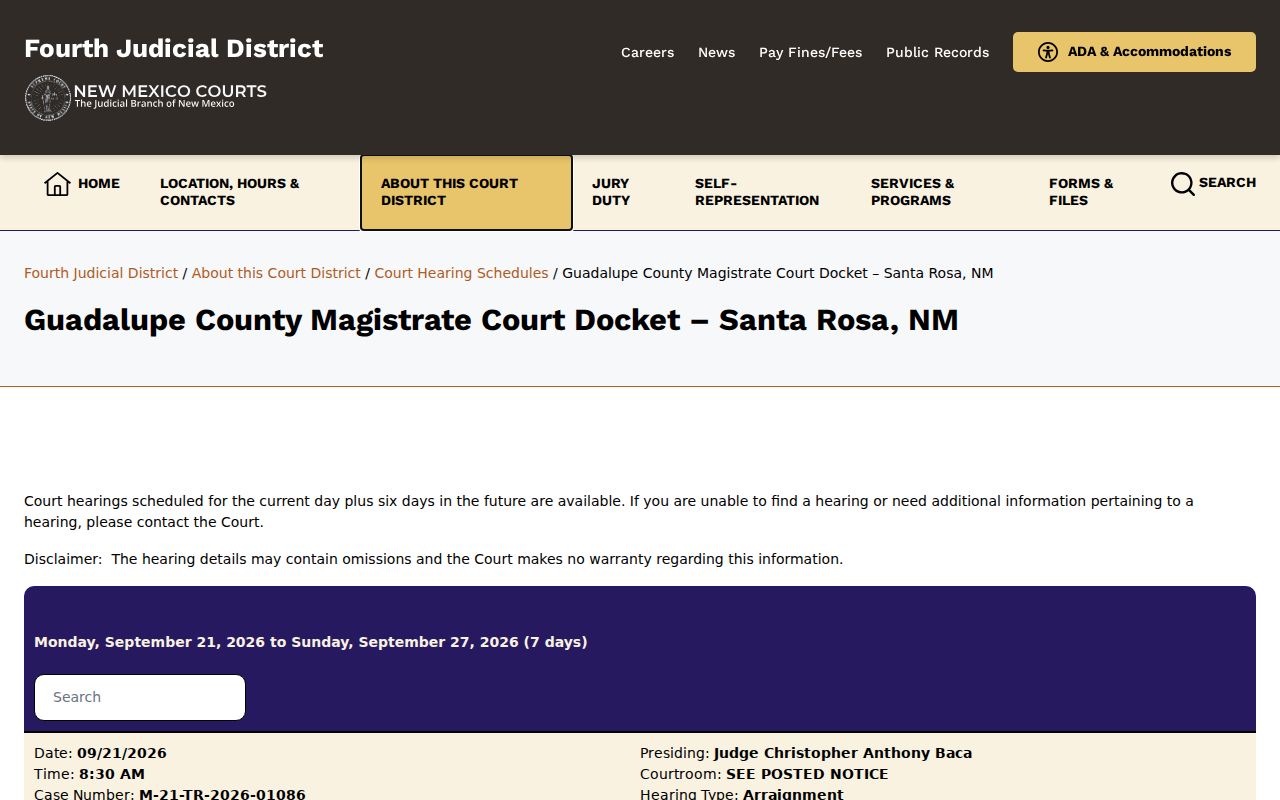
For any live Guadalupe County warrant question, call the magistrate court clerk and ask about the bench warrant directly.
How a Guadalupe County Bench Warrant Is Issued
A Guadalupe County judge can act on an alleged failure to appear, a missed subpoena, a release-condition violation, contempt, unpaid fines or costs, probation noncompliance, or a skipped first-offender-program session. The judge's order and the case record control. One missed event does not tell you which remedy the court will allow. On the district side, Form 9-212 covers bond, a defendant description, extradition, the originating agency, and the return. Magistrate and municipal cases use Form 9-212C instead, with its lower-court trigger boxes and release choices. Both forms are process aids, not a countywide status database.
- Identify the case and court.
- Ask the clerk whether the judge issued a warrant.
- Ask about payment, bond, hearing, motion, or attorney-arranged surrender.
- Ask how the court confirms removal from the information system.
Guadalupe County Bench Warrant vs Arrest Warrant
The two warrant types start from different places. A Guadalupe County bench warrant follows an alleged violation of a prior court requirement. An arrest warrant rests on a probable-cause finding that a person committed an offense. Their forms, triggers, bond conditions, and court routes can all differ. Search-warrant authority is separate again, since it targets a place, person, or property rather than a court appearance.
| Question | Bench warrant | Arrest warrant |
|---|---|---|
| Typical trigger | FTA, subpoena, contempt, payment, probation, or release issue | Probable cause for an alleged offense |
| Key form | Form 9-212 or 9-212C | Forms 9-209 and 9-210 |
| First call | Court holding the existing case | Court named in the criminal file |
| Resolution question | Recall, hearing, payment, bond, or surrender process | Bond, appearance, and counsel process |
Have the case number and court name in hand before calling, so a Guadalupe County bench-warrant question lands with the right agency.
How to Resolve a Guadalupe County Bench Warrant
Call the issuing court first, not the sheriff, jail, or courthouse counter. Ask whether Guadalupe County requires a judge hearing, an attorney motion, bond, payment, a scheduled appearance, or a set surrender route. No public page lists a countywide warrant counter or an after-hours bond window.
Verify first: A payment can address a financial obligation while another court condition remains open. Ask the clerk what exactly will be recalled or cleared.
- Locate the court and case number in Case Lookup or the citation.
- Ask the clerk for the current status and permitted resolution route.
- Consult counsel about a motion, bond, appearance, or surrender.
- Request a receipt, order, or written confirmation of recall or removal.
- Recheck the case after the court says the status changed.
Guadalupe County Bench Warrants and the Eight Trigger Boxes
Form 9-212C doubles as a plain-language inventory of why a lower court might issue a bench warrant. The form itself decides nothing. It cannot tell a Guadalupe County caller whether payment, bond, or a recall is open to them. Use it to ask the court one precise question.
- Missed court date
- Failure to attend a required appearance.
- Missed subpoena
- Failure to appear after a subpoena requirement.
- Release condition
- An alleged violation or review issue concerning release.
- Contempt
- An alleged violation of a court command.
- Fines or costs
- Nonpayment identified by the court as a warrant basis.
- Probation
- Failure to comply with a probation requirement.
- First-offender program
- Failure to appear in a program-related matter.
- Other facts
- A court-specific basis that must be explained by the clerk.
Which Guadalupe County Court Issued It
The case level tells you which Guadalupe County court to call. The Fourth Judicial District Court sits at 1448 Historic Route 66, Suite 5, Santa Rosa, reachable at 575-472-3888. The county magistrate courthouse is at 1633 Historic Route 66, phone 575-472-3237. Santa Rosa Municipal Court sits at 244 S. Fourth St. and answers at 575-472-4232. Vaughn Municipal Court is at 320 E. Eighth St. with 575-584-2206. The county clerk handles recording, elections, probate, oaths, and certifications, not criminal warrants. Take bench-warrant questions to the district, magistrate, or municipal clerk instead. The court directory shows exactly why address and phone matter for routing a call.
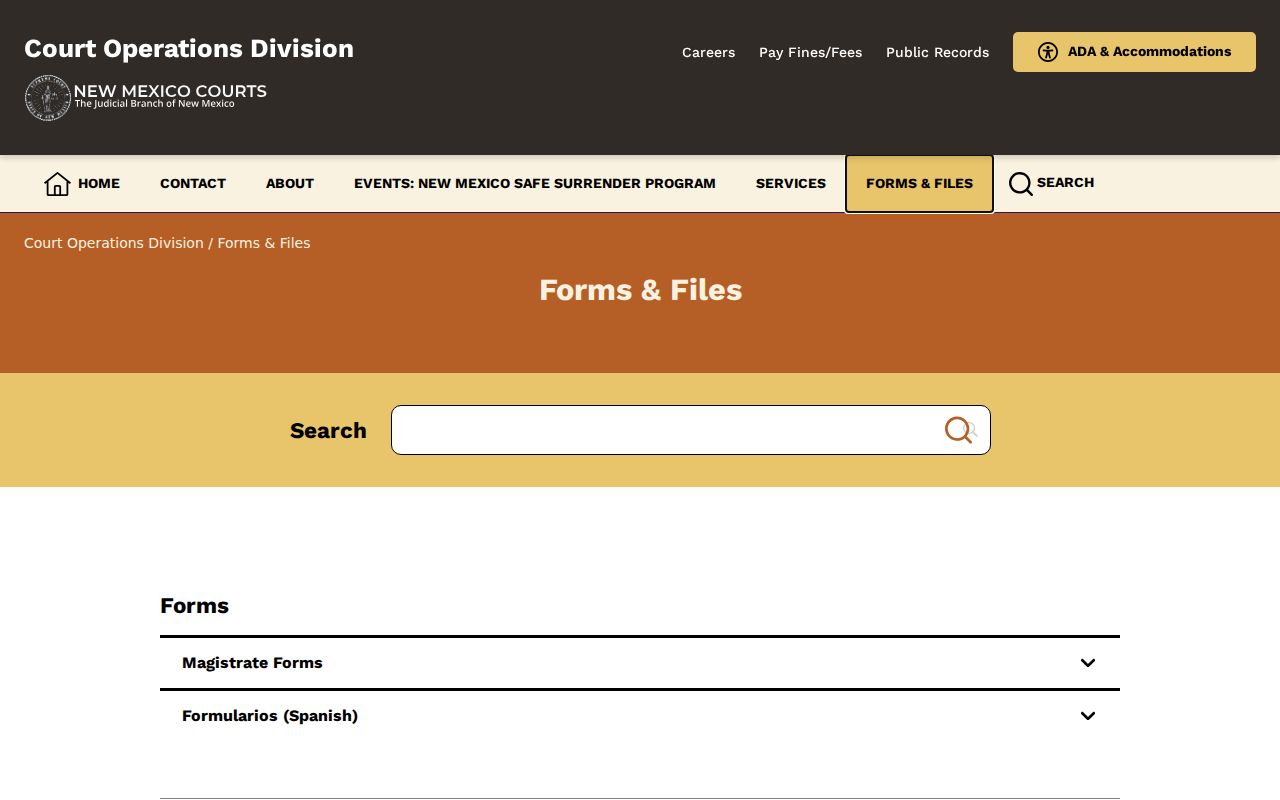
The official forms catalog offers useful context, but only the issuing Guadalupe County court can give case-specific instruction.
The $100 Magistrate Fee and Municipal Exception
Form 9-212C lists a $100 bench-warrant fee for magistrate court where authorized under NMSA 35-6-5. The same use note says a municipal court must modify the form when it lacks authority to assess that fee. So do not assume the magistrate amount applies to a Santa Rosa or Vaughn case. Ask the court to state the current figure and whether it folds into an eligible payment route. The county publishes no motion-to-recall fee, bond schedule, or accepted payment method. A clerk can describe the process; legal strategy belongs with counsel.
District Bench Warrants Use a Different Form
Bench warrants at the two levels travel on different paper in Guadalupe County. District criminal files run on Form 9-212, while magistrate and municipal cases use Form 9-212C. The district form carries fields the city version lacks: bond type, defendant description, extradition, and return. That tracks the higher court level. So treat it as a district court document, not a city-court payment slip. For a district file, ask whether the judge wants an attorney motion, a written order, a bond appearance, or a surrender arranged through counsel; the district courthouse keeps weekday hours but posts no special warrant window or walk-in surrender rule.
Proof of Clearance After Payment or Appearance
Ask the Guadalupe County court what paper proves your warrant changed status. It varies by case. A receipt, a judge's order, a clerk's confirmation, a warrant return, a recall or cancellation entry, or word that the law-enforcement information-system entry came out all count. A payment receipt alone may not show every condition was resolved. Traffic matter? Ask how the court reports compliance or rescission to MVD. Keep the case number and the date of every call. Then recheck Case Lookup, and ask the clerk whether the public display lags the court's internal action. For a fuller picture of how Guadalupe County resolves an outstanding warrant, return to Guadalupe County warrant records and use the court contacts listed there.